


Finally. The wait is over. The May CME/NYMEX natural gas contract dropped 4.7 cnts to close at $1.984/MMbtu. June was lower by the same amount, closing at $2.105. It is still another 10 year low and another milestone in the onslaught of shale production in the year-of-no-winter. The last time we saw a Natgas futures contract close at this level was Jan 28, 2002. For reference, that was one day before President Bush’s ‘Axis of Evil’ State of the Union speech. Seems like a long time ago.
|
Notice: Today and tomorrow I’m attending the Platts 6th Annual Rockies Oil & Gas conference at the Grand Hyatt Denver. There will be lots of presentations on all things Rockies, including Niobrara, Bakken, oil, gas, NGLs, pipelines, rail, trucking – you name it. Blog postings will be coming over the next few days, and if you want to follow realtime, I’ll be tweeting the high points @rustybraziel. I tried this one time before and did not do such a great job. Hopefully this time will be better – Rusty. p.s. If you don't want to become a Twitter person you can see the postings on the Tweets tab of this website. |
Yesterday’s cash market was worse. The ICE day-ahead index for Henry Hub came in at $1.91, down 8 cnts. Ship Channel was $1.84. CIG mainline (in the Cheyenne, WY vicinity) got the low price honors at $1.73.
We’ve been talking about this day for months, and the prompt futures contract has been flirting with $2.00 for weeks. Now that the price has broken through to the other side of $2.00, what does it mean to the markets?
Aside from another nickel lower pricing and hitting a few trigger points on the technical charts, not much. This is probably the most anticipated non-event in recent gas price history. But hey, it is a milestone, and what are milestones if not opportunities to contemplate the deeper meaning of things. So in the tradition of pop culture everywhere, let’s look at the top ten most significant implications of sub-$2.00 natural gas.
1. Producers of dry gas are in trouble. They are receiving a lot less money in the door than was budgeted, because nobody did a budget based on sub-$2.00 gas. Those that had substantial unhedged volumes will need to borrow money, sell assets and scramble to make ends meet. Private equity funds and other strong players are circling in the sky above – and I don’t mean to lend a helping hand.
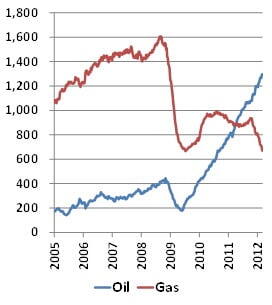
2. Dry gas drilling is dropping like a rock. This graph below shows the latest Hughes rig count numbers for U.S. crude oil and gas rigs. The gas count is off 17% since the first of 2012.
3. But those darned producers are still making more -- gas production has declined by only a couple of Bcf/d since the high point late last year and has actually increased in the past few weeks (see The Wall. Gas production up). There are at least three contributing factors to this development: (a) due to the huge increases in the productivity of natural gas rigs, one rig can now generate two to three times the incremental production of rigs just a few years back; (b) associated gas from growing crude oil production is increasing; (c) producers are still aggressively pursuing wet gas plays.
4. Gas processing is hugely profitable (discussed extensively in the Golden Age of Gas Processors).
5. Industrial and commercial gas users are seeing the economic benefit of cheap fuel. Industrial segments like methanol, fertilizer, steel, etc., that are heavily fuel dependent are expanding existing plants and building new ones.
6. Power generators are burning as much gas as possible, mostly at the expense of coal, which is experiencing low demand and inventory containment problems of its own. Almost all the new power plants being built are natural gas fired, reducing emissions as coal plants are retired.
7. To the extent possible, E&P companies have shifted their drilling budgets to crude oil. This has resulted in a resurgence of productivity in that market as well. In effect, cheap gas prices have forced shale technologies (horizontal drilling and multi-stage fracking) to move much faster into crude than would have happened otherwise.


Comments
low nat gas prices." Stole that quote from someone.