


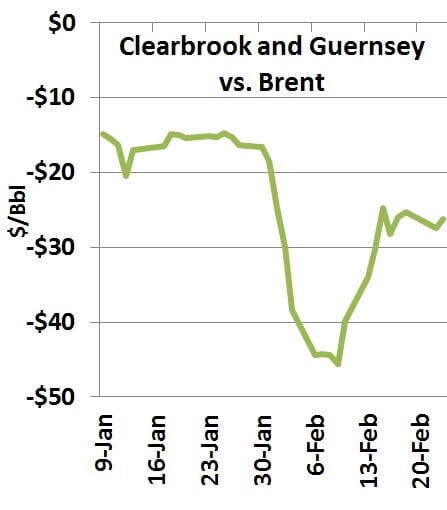
In the first week of this month, crude oil prices in the Bakken crashed. We talked about the development here in Back to the Future – What happened to Bakken and Canadian Crude Prices? At one point, the Bakken was trading $45/bbl under Brent. It is not over yet. Prices at Clearbrook, MN are still $26/Bbl under Brent. Was it just a rogue wave? What can we learn from this market event? And how can we recognize the onset of similar disruptions in the future?
For the reader who may not be familiar with the geography of Bakken crude flows, let’s look at the pipeline network. There are two – and only two -- ways out of ‘Dodge’, so to speak. See the map below. Crude oil moves east through Clearbrook, Minnesota and then south to the Midwest refinery centers. Or it moves south to Guernsey, Wyoming, then to Rockies refineries and to those same Midwest refinery centers.
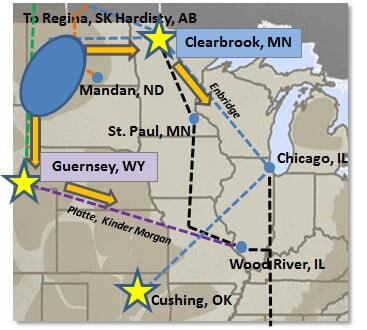
Those two trading hubs, Clearbrook and Guernsey are the primary gateways out of the Bakken and the Rockies. In both cases, Bakken and Rockies crude production competes for pipeline capacity with Canadian crude which moves in those same pipelines to the same refinery centers.
This is a graph of the differential between Bakken crudes at Clearbrook and Guernsey versus Brent. Back in January, prices at those points were rocking along about $15-16/bbl under Brent, not bad when you consider TI [1] was $10/bbl under Brent. But all of a sudden, things came apart. Bakken crude at those two trading hubs dropped down to almost $45/bbl below Brent, and it happened almost overnight – all in the first four days of this month.
Bakken producers, most of whom sell their crude at Clearbrook and Guernsey or at prices related to those two points were shocked, mad or just freaked out. Not a fun fact to explain to the boss.
Like you always see with one of these big price moves, there were a lot of things going on at the same time. In the global market, the Iranian nuke thing was pushing prices up – so Brent was increasing. TI at Cushing was starting to move up, but the delay of the Seaway reversal to June started to weigh on TI prices, and the differential versus Brent started to widen from the $10-$11 range back to the $17-$18 range. That gets us to the Bakken, and there we had a number of factors converge on the market -
Warm weather across the Williston has allowed uninterrupted operation for virtually the entire winter – That’s unusual that part of the world, and the result has been an incremental 20 Mb/d of production coming on each month. Canadian production has been increasing too; Enbridge pipeline inventories in Canada have been unusually high; Pipeline capacity is full. Demand has been slack due to the weak economy and shoulder-month dynamics; Some refineries are doing turnarounds. Many new rail alternatives for Bakken crude are still under construction. Then the straw that broke the camel's’ back - BP had an unplanned shut-down of its 100 mb/d FCC unit at Whiting, Indiana, creating a surplus of crude oil in the market. That put a big refinery buyer in the market as a seller. It was the perfect storm. And the price got crushed.
What can we learn from what happened in the Bakken this month? At least three things.
- First, local market conditions trump whatever is happening in the global market. If supply exceeds demand and transportation capacity is not available to fix the situation, prices are going to feel the impact.
- Second, these oversupply situations can build for a long time, then trigger in an instant. For years we’ve seen in the gas business that the trigger point is somewhere in the 85% to 95% range. When capacity utilization gets to those numbers price starts to move quickly. When capacity is maxed out, there is no limit to what can happen to prices – as we saw in the Rockies five years ago when prices dropped to a nickel, then a penny. Most people will tell you that that can’t happen to crude oil because of the possibility of truck and rail transportation. I wouldn’t bet the farm on it. This market is changing quickly and we haven’t seen this kind of growth in the crude oil markets for a very long time.
- Third, don’t be like the crew of the Andrea Gail and ignore the obvious signals. It is more important than ever that the market monitors pipeline capacity and utilization. Billy Tyne can’t wait for the Coast Guard to tell him it is the Perfect Storm. And you can’t wait for the price feed to tell you that flows have hit 99% utilization. You don’t want to go down with the ship.
[1] West Texas Intermediate at Cushing, OK
