You are here

Rail it on over to Albany – Moving Bakken East

Move over old dog ‘cause a new dog’s moving in.  That dog would be crude oil from North America producers -- mostly light-sweet crude from the Bakken – moving by rail to Albany and on to other points east.  Not only is it a good market for Bakken oil, it might just be the ticket out of financial meltdown for East Coast refiners. 

On Friday I was a speaker at the 2012 U.S. Energy Services Annual Conference in Phoenix.  The crowd was a very diverse mix of energy users – across the hydrocarbons spectrum – power, gas, petroleum products, ethanol, etc. These folks are grappling with the changes in energy markets in their daily operations, and among many issues wanted to understand the implications of changing crude costs, refinery capacity and crude-by-rail. 

Note: Check out contributor Kyle Cooper’s natural gas markets posting this morning on the Markets page. Kyle’s most recent weekly will be there each Monday morning.  Today’s is Natural gas at $2.50 significant for coal; small storage build.

I’ve been using a picture of one of the Bakken loop track facilities in my presentations to help illustrate the magnitude of these terminals.  It turned out that one of the developers of this terminal was in the audience. The picture of that terminal follows.
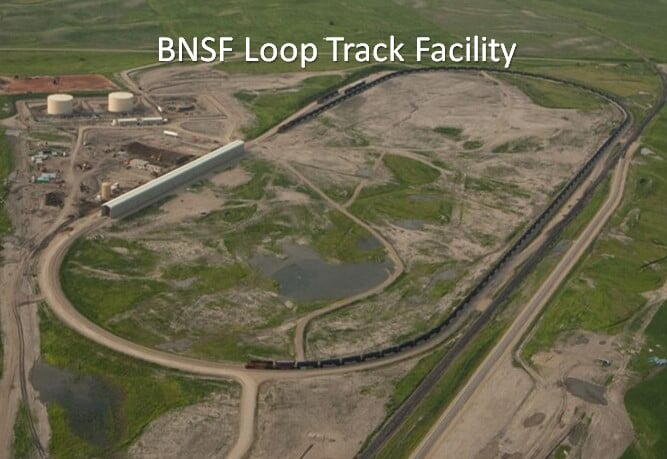
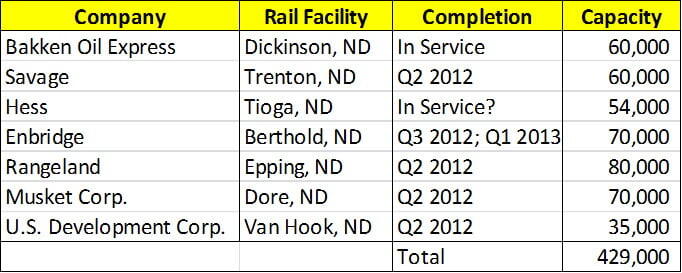
Obviously this is not your father’s choo choo.  Some of these things can accommodate two or more unit trains of 100 cars each.  A typical rail car holds 30,000 gallons, or 714 barrels.  So 100 car unit trains can hold 71,400 barrels.  These facilities are popping up all over. The table below from Bentek’s PADD 4 Rockies Oil Observer shows seven new facilities that are already in service or will be in service in the very near future, adding 429,000 b/d by the first quarter of next year.  Bakken Oil Express in Dickinson is in service.  Coming in Q2 are Savage at Trenton, Rangeland at Epping, Musket at Dore and U.S. Development at van Hook. Hess at Tioga is in service with 25,000 Mb/d today and will be at 54,000 b/d by year end.  Enbridge at Berthold will be at 10,000 b/d by Q3 2012 and 70,000 by Q1 2013. 
These facilities are on top of seven existing rail terminals in North Dakota, some of which have been around for years.  These include Stampede, Donnybrook, Ross, Stanley – EOG, Minot, Dore, New town and Beulah.

Rail is making inroads in other crude plays.  U.S. Development (USD) has an Eagle Ford terminal going in just south of San Antonio.  It is scheduled to be completed in July.  USD also has the Niobrara Crude Terminal in Colorado.  Rail terminals from South Texas to Ohio are seeing record volumes of crude tank car shipments.

Don’t take those capacity numbers at face value.  Like so much of the rapidly expanding hydrocarbons infrastructure these days, there are constraints inbound barrels and on take-away capacity. These constraints can come in several forms, including:

  • Loading delays  For a terminal that can handle a 100 rail car unit train each day, it must be able to receive the train, load the train and get it back on its way within 24 hours.  The oil must be ready to load in tankage and the next train must be ready to load when the previous train pulls out (thus the double loop terminals).  Few facilities in North Dakota are operating at anything close to their stated capacity today.
  • Rail congestion into and out of the terminals.  If congestion on inbound/outbound tracks slows the loading process, the facility will not achieve capacity.  Many of these rail lines are not geared up for the wear-and-tear that they are receiving.
  • Availability of rail cars.  Not only has the availability of rail cars been relatively tight, anything that slows the ability of rail cars to make deliveries and return to the loading terminal for the next load ties up cars and effectively reduces the supply of cars.
  • Limited number of receiving terminals with the capacity to receive unit trains.  There is a huge difference between the cost for unit train delivery (a compete train of 80-100 cars going from one single loading point to one single delivery point) versus manifest service (less than train-load lots that must be broken up and delivered several cars at a time).  This unit train versus manifest service is one of the biggest challenges facing crude-by-rail companies today.

Where are all these trains going?  To the extent that capacity is available, these cars are going to terminals that can unload unit trains and get the empty cars back on the rails ASAP.  The favorite destination for crude-by-rail cars is St. James, Louisiana.  Prices are high and the USD terminal at St. James can take full unit trains up to 65,000 b/d.  A few weeks back USD announced that the facility is doubling in size to 130,000 b/d (thus two unit trains per day). This facility has a fully automated 52-spot high-speed railcar offloading rack.  A lot of the Bakken crude from EOG’s Stanley terminal is going to EOG’s Stroud, Oklahoma terminal  - that can get barrels into nearby Cushing. Still other manifest volumes are getting to various points along the Gulf Coast and to the Pacific Northwest.

And increasingly, rail volumes are getting to the East Coast.  Yup, all the way from the Bakken and other producing regions to New York City!  (New York City??)  Well, at least the barrels are getting to refineries that supply product into the New York Harbor market.  A lot of these barrels are making their way to East Coast refineries by way of the Global Partners rail terminal in Albany, NY.

Global started receiving Bakken crude last October and today can receive 80-car unit trains.  The company reported that it had received 15 unit train loads of Bakken oil in the first two months of 2012.  The crude is delivered into a portion of the terminal’s 1.4 million barrels of storage, then loaded on barges to move down the Hudson for delivery to coastal refineries.  And a big expansion is underway.  By the end of this summer Global’s Albany terminal will be able to unload two 120-car unit trains each day and achieve up to 150,000 b/d of throughput capacity. 

The economics can look pretty good. Recall that the Bakken-to-Cushing-to-Gulf Coast differentials average in the high $20s, occasionally spiking much higher (see Bakken’ and a Rollin’ and Perfect Storm).  East coast refineries have the highest priced crude in the country.  So lets’ assume the differential is $28/bbl on average.  It takes about $2/bbl to load the rail car.  Another $12 to move the car to Albany.  Then another $2/bbl to unload into a barge.  Finally $5/bbl for the barge leg. Add on another dollar for the cost of the car, and you are up to $22/bbl.  At a $28/bbl differential that is $6/bbl to be split somehow between the producer, transporter and refiner.  Manifest volumes will be more expensive than this.  But regular, term shipments of standardized unit trains can be a lot cheaper.  Perhaps getting up to $10/bbl in margin or more.

The more Bakken and other domestic crude that gets into the East Coast, the better off those refineries are going to be. Sadly, over the past couple of years East Coast refineries have been dropping like flies.  Western Refining at Yorktown VA and Sunoco Eagle Point, NJ refineries kicked the bucket in 2010. Sunoco at Marcus Hook, PA and Conoco Phillips at Trainer, PA are also shut down.  Trainer is the refinery that Delta is looking to buy and restart.  Other refineries in the region are hanging on by their fingernails due to high waterborne, globally priced crude.  So if enough domestic crude can get there, and if the refineries can benefit from enough of the cheaper pricing, it could keep these refineries in business.  And push out high dollar waterborne barrels that have traditionally supplied the East Coast market.  Move over old dog ‘cause a new dog’s moving in. 

Move It On Over was the first Hank Williams' first country hit reaching in 1947 rank #4 on country singles chart.  (For you youngsters, this is Hank Williams Jr.’s father).  The song was covered a few years ago by George Thorogood.

Each business day RBN Energy posts a Blog or Markets entry covering some aspect of energy market behavior. Receive the morning RBN Energy email by simply providing your email address – click here.