


At the Platts Oil and Gas Conference in Denver last week, one of the best presentations was from David Stone, Director Portfolio and Business Strategy with Marathon’s Onshore Exploration group. His presentation was titled The Bakken System and the Vision For growth, and covered the resource potential, projections, and Marathon’s position in the play. I’ll hit the high points from my notes taken during the presentation. I’ll also reference a few of the slides included as an attachment at the bottom of this blog posting.
As you probably figured from the title of this piece, the overarching message was one of abundance. There is a lot more to the Bakken than just the Bakken. Next door there is the Lodgepole above and the Middle/Lower Three Forks below. But higher above there is also the Tyler system and the Madison group. And further below the Duperow, Winnepegosis, Red River and Deadwood. This thing could go on forever.
The Bakken and all of the other formations that have been generically labeled as Bakken is a huge play that has forever changed the U.S. oil production landscape. It has grown rapidly and shows no signs of slowing down. In fact, things are speeding up. Thus our title, “With a Bakken well, they drilled moe moe more”. Apologies to Billy Idol.
The following are notes on six of Mr. Stone’s slides. (download pdf below)
* Slide #4 - North Dakota is now the 3rd largest producing state. As of December 2011, 202 rigs were operating with 95% targeting the Bakken and Three Forks.
* Slide #5 is a chronology of the development of the Bakken as of 2010 showing the Elm Coulee discovery, the Upper Bakken shale at Billings Nose, the 2005 discovery of the Nesson Anticline, the 2006 discoveries of Parshall and Bailey, and the 2008 discovery of the Rough Rider Field. Good background on the geography of drilling to date.
* Slide #6 shows the North Dakota Bakken and Three Forks production and well count from Jan. 2006 to Jan 2012. Lots of wells. Lots of growth.
* Slide #9 is a great generalization of the Bakken system, based on the Oreo Cookie Model. Finally some geology I can understand.
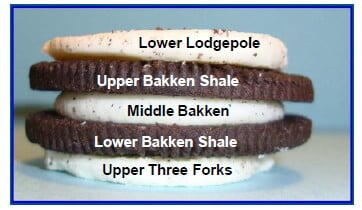
Some of Mr. Stone’s comments: (a) the majority of production from the Middle Bakken – it is under full development. (b) the Upper Three Forks is developing, really kicking off in 2010 because it was not known if middle Bakken fracs would take in the Three Forks. There are still some debates going on; (c) also intriguing is the Middle Three Forks. It is an emerging play; (d) and above the Bakken shale is the Lodgepole, with a unique opportunity system – up to 300 square miles.


