The coal to gas switching debate has been raging for months. How much is happening? How long will it last? Could switching continue to increase? Will the generators save the producers from themselves? So far this year, that latter assertion seems to be the case. Additions to natural gas power burn by electric generators have been about the only thing propping up natural gas prices. If the generators weren’t burning so much gas, the storage surplus would be through the roof. Last week EIA announced that natural gas matched coal’s share of U.S. generation for the first time in April. That’s a big deal. In today’s blog “Talkin bout My Generation – Coal to Gas Switching Part I” we uncover the drivers behind the shift to natural gas generation, and set the stage for a deep dive into the longer term implications for gas markets.
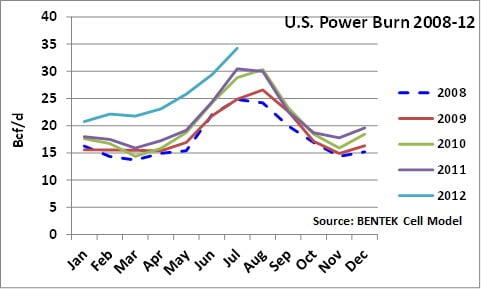
First, let’s look at the power burn numbers. The graph below tracks gas burned for power generation over the past five years, based on numbers from the Bentek cell model. Back in 2008, power burn never got higher than 25 Bcf/d on an average monthly basis. Prices dropped in 2009 and that was the first year of coal-to-gas switching, with most of the increases coming in the spring and late summer. In 2010 power burn was way up, but paradoxically coal to gas switching was down. We’ll get back to that in the paragraphs below. Last year power burn was about the same as 2010. Then starting in January of this year, gas prices dropped below $3.00/MMbtu and power burn kicked into high gear. It has been there ever since.
So let’s get back to the coal-to-gas switching phenomenon. We’ll begin our examination by addressing two questions. First is there adequate generation capacity out there to allow more switching from coal to natural gas? Second if there is adequate switching capacity, what are the constraints keeping more coal to gas switching from happening? For those not conversant with the nuances of generation unit dispatch, we’ll need to cover some of the basics of power generation economics, so put on your hard hats and hold tight.
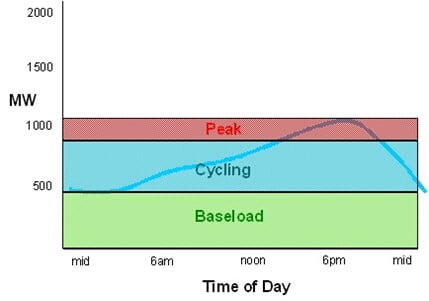
We need to get some terminology defined while we are still fresh to the topic – starting with the daily load or demand curve. The load curve (see the blue line on the chart below) indicates how much electricity is being used at any hour of the day. As you can see from the chart, the load curve passes through three distinct types of generation capacity – baseload, cycling and peak. By baseload capacity we mean the generation capacity that is run around the clock to meet the regular daily demand at the off peak level. On top of baseload capacity is intermediate or cycling capacity that ramps up and down during the day as demand fluctuates. Finally there is peak capacity that only gets used during the peak demand hours (usually late afternoon / early evening), and sometimes is not used at all.
Next we need to understand the Law of the Generation Stack. The Law of the Generation Stack states that generation is brought on line in order of the variable cost of operating the plant (although there are other factors – notably reliability - that have to be taken into account). Least expensive units first and most expensive units last – a process known as economic dispatch. Note that this is VARIABLE cost, not total cost. The Law of the Generation Stack ignores FIXED costs. So even though a nuclear plant costs a zillion dollars, the variable cost of running a nuclear plant is low.
Since baseload capacity runs around the clock it follows that baseload generation uses the least expensive variable cost units. Nuclear runs as often as practicable because these have the lowest variable cost (fuel in a nuke is not variable). Next in the traditional baseload generation “stack” come coal steam plants. Coal steam plants burn coal to make steam to turn turbines to generate electricity. Coal plants get their place at number two in the stack after nukes because coal is traditionally the least expensive fossil fuel. You also need to know that stopping and starting a coal plant, apart from being disruptive and slow, raises the cost of running the plant prohibitively – so if you are going to run a coal plant it only makes sense to run it baseload.
Next in the generation stack come intermediate or cycling capacity. Plants in this part of the stack must be flexible to ramp up or down rapidly during the day in response to demand. Generators can use hydro electric capacity for cycling because they control the water flows at hydro dams and can bring the power on quickly. But hydro only works when and where it is available. By far the most common sources of cycling capacity are natural gas combined cycle generation turbine (CCGT) plants. These natural gas plants burn gas to make steam to turn turbines to generate electricity - but they also recycle heat to boost plant efficiency. CCGT plants are less expensive than coal plants to build and they run more efficiently. They can also be ramped up and down more easily than coal and may stop and start many times during the year.
After CCGT in the generation stack we get into peak load capacity. Peak load or “peaker” plants only run when electric demand increases above the intermediate or cycling level. This is typically during the afternoon and particularly during the summer when folks crank up their air conditioning. There are many different peaker plant technologies but they all have to be able to fire up quickly. Sometimes CCGT plants are used as peakers. But generally speaking the peakers are the more expensive units, including natural gas combustion turbine plants (not combined cycle) as well as units that run on LNG, oil fired plants and even propane fired units. The idea with peakers is to keep the lights on reliably when demand peaks without being so concerned about generation costs. You only run the peakers when you have to because they are expensive. You don’t run peakers as baseload or intermediate generation because they are too expensive.
[To keep it simple, we are not going to get into wind generation here. Wind is becoming more of a factor in the generation stack, but it has the unfortunate characteristic of only being available when the wind blows. That causes all sorts of complexities for utilities with wind in the stack, but that is beyond our scope here.]
Sorry for the lengthy explanation but it does clear the ground for our first major coal to gas switching “aha” moment today. That point is that coal to gas switching is about the interchange of capacity between baseload and intermediate capacity– not peakers. That’s because there are essentially no coal peaker plants that can be switched to natural gas. For the most part, when coal to gas switching occurs, its going to be between baseload coal steam and intermediate natural gas CCGT plants.
Now hopefully we’ve set the scene for which generating plants we are talking about, we can answer today’s first question. Is there enough CCGT capacity available out there for more coal switching to be feasible? The answer to this question is yes. That’s because of a huge CCGT building spree by Independent Power Producers (IPPs) between 1990 and 2007 when over 168,000 MW of CCGT capacity was built at 345 plant sites. This building program was equivalent to adding 23 percent to the entire national generating fleet that existed in 1990. It was classic overbuilding based on the premise of low natural gas prices. When gas prices went through the roof in 2008, the building stopped.
Many of these CCGT plants ran at average capacities as low as 30% prior to 2009, the year after gas prices hit the skids, and the first year of serious coal to gas switching. That year about 3 Bcf/d of coal-to-gas switching took place. The next year in 2010 it was hot in high gas usage areas like Texas (another one of those record breaking summers). So gas prices were higher as utilities used more intermediate/cycling and peaking capacity. Paradoxically, those higher prices actually cut back the volume of coal-to-gas switching to less than 2 Bcf/d. More gas was burned, but it did not replace coal. It added to coal. The market situation was similar last year, but switching rebounded back to about 3.0 Bcf/d, mostly due to geography of the heat and better preparation for switching on the part of some utilities and power generators.
But then 2012 happened. Shales continued to drive natural gas production ever higher. Gas to coal switching came on with a vengeance just as soon as natural gas prices dropped below $3.00/MMbtu in January, and has been huge ever since. The switching number could get north of 7 Bcf/d this year. You can see the 2012 shift in the graph above.
But even at that level there is theoretically room for a lot more switching. Although some CCGT plants have run at up to 80 percent capacity this year because of coal switching (as reported by FBR Capital Markets in a June report on the topic), this has been limited to a small number. Even during the summer, FBR reports, CCGT plants have been used at 50 to 55 percent of capacity since 2007 and are not expected to exceed that level this year. Bottom line – there is capacity left for more coal switching.
So if there is switching capacity available, what is preventing more switching? Lets look at the drivers that impact coal switching:
Location: switching from coal to gas generation requires the CCGT unit to be able to meet the same electric demand in roughly the same location without potentially causing congestion on the transmission grid. That means if coal plants are far away from CCGT plants, switching is not an option without a significant investment in transmission infrastructure. In some regions of the US such as the Midwest, there are few CCGT plants available to replace coal.
Operational Requirements: electric power system operators need to maintain high levels of reliability and reserve capacity margins in order to keep the lights on. This results in operational requirements to keep coal plants considered important for reliability purposes running.
Temperature: if the summer is really hot then more CCGT plants will naturally run as cycling capacity but not at the expense of baseload coal plants - but on top of the coal, since at a certain level of demand both coal and CCGT plants will run in order to meet demand. So higher temperatures cause more gas burn, but don’t cause coal switching.
Other Plant Outages: If baseload nuclear plants take outages or if hydro plants can’t run because the water flows are not available, the CCGT plants are likely to take up the slack – but again this will be in addition to - not instead of - coal.
Plant Fuel Costs: if the fuel cost of a natural gas CCGT plant stays far enough below the fuel cost of a steam coal plant, then the CCGT plants will be dispatched more often than coal because they are costing less to run. If the fuel cost of a CCGT gets closer to the fuel cost of a coal plant then switching will decline.
Of all these drivers, fuel cost is the only factor that utilities can base coal to gas switching decisions on and the one that is most likely to cause any increase in coal to gas switching. In fact fuel cost has been the driver behind almost all the coal to gas switching we have seen so far. [It is true that some coal to gas switching is occurring due to natural attrition because smaller, older coal plants fail to meet Environmental Protection Agency (EPA) pollution attainment standards. Faced with high costs to install cleaning equipment, plant owners are decommissioning these older plants but not at a rate that is going to eat up the natural gas storage surplus.]
So now that we have established that plant fuel costs are the principal driver behind coal to gas switching we need to understand how to calculate and compare fuel costs. That’s what we’ll cover tomorrow in Part II.
Each business day RBN Energy posts a Blog or Markets entry covering some aspect of energy market behavior. Receive the morning RBN Energy email by simply providing your email address – click here. |