US domestic crude oil production took off in the past year. Most of the production growth is coming from three shale oil plays – the Bakken, Eagle Ford and Permian basins. A number of factors have combined to allow rising production to continue. Today we review what sustains increased crude production and whether it can continue.
The chart below shows total US domestic crude production since the start of 2009. Around August 2011, the level of production started to ramp up dramatically. Despite a brief respite when crude prices fell below $80 / Bbl earlier this year, production is rising again. The latest data from the Energy Information Administration (EIA) shows that between September 2011 and July 2012, production increased from 5.6 MMb/d to 6.3 MMb/d - that’s a 62 Mb/d production increase every month.
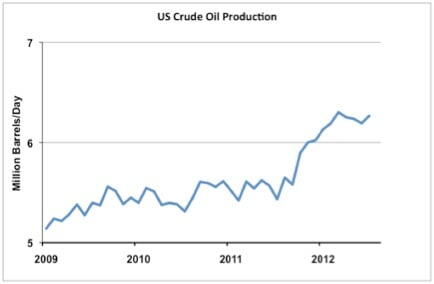
Source: EIA Data from Morningstar
Rig Count and Drilling Efficiency
The US drilling rig count has been rising rapidly since 2009 (see chart below) and has continued to grow. As the price of natural gas fell in 2011 and into 2012 producers began to turn away from dry natural gas. The majority of the drilling rigs freed up from gas production were then moved into crude oil or wet gas (natural gas liquids rich) production.
Between September 2011 and August 2012, the number of rigs drilling for crude increased from 1063 to 1423 – (25 percent). If you look carefully at the chart, you can see signs of the rig count leveling off earlier this summer. However, the rig count number does not tell the whole story. We also need to consider increased rig efficiency. Producers are continuing to report increased rig efficiency in their presentations to investors. Continental Resources (the number 1 Bakken producer) cited completion and drilling efficiencies and multi-well pads as areas for expected savings and their rigs were 40 percent more productive (wells/rig) in 2012 than they were in 2011 (source Investor Presentation).

Source: EIA Data from Morningstar
High Prices
Increasing production rates are being underpinned by positive drilling economics. Bentek estimates that the internal rates of return (at $90/Bbl oil prices) for the Bakken are 60 percent, the Eagle Ford 68 percent and the Permian Basin 85 percent respectively. The current price of WTI crude oil is $85 /bbl. Analyst Raymond James suggested in a July 2012 brief that producers in these basins will continue to make economic returns at $65/Bbl. The NYMEX WTI crude forward curve (October 26, 2012) indicates that prices are expected to remain above $85 until 2020. The forward curve makes hedging to protect production prices at these levels feasible.
Takeaway Capacity
Higher oil production is also being facilitated by the fact that crude oil takeaway capacity from the three main basins has proven flexible enough to handle the increased volume. As we have seen in our analysis of the development of these crude plays, the infrastructure required to get crude to market has been built in the Permian Basin and the Eagle Ford quite rapidly. That is because these fields are close to the Gulf Coast refinery market and producers were able to leverage existing pipeline capacity as well as building new. In the Bakken, the pipeline takeaway build out was slower because the location is more remote. In response Bakken producers turned to a more flexible alternative – rail tank cars.
Rail Tank Car Movements
According to the Association of American Railroads, 241,000 railcars moved petroleum during January-June 2012 versus 174,000 over the same period in 2011. Most of that growth in oil shipments was from the Bakken. In October the North Dakota Industrial Commission reported that 56 percent of September crude oil takeaway was by rail versus 44 percent by pipeline. As we have reported previously (see A Tank Car Train for Hire Part II and Railing Against the Pipelines), rail transportation has proved advantageous for producers in spite of higher costs. Here’s why:
Getting Past the Cushing Logjam
Rail transportation has allowed continued increases in crude production when pipeline capacity was not yet available or full to capacity. Bakken crude has been able to bypass by rail a “blockage” in the pipeline delivery system that restricted movement of crude from the Midwest to the Gulf Coast. That logjam occurred at Cushing, OK because increased Canadian and Bakken crude production delivered into the Midwest exceeded demand and pipeline capacity to the Gulf was not available to relieve the pressure. This led to a significant storage build at Cushing and downward pressure on the WTI NYMEX Cushing delivered crude prices. The blockage at Cushing caused the differential between crude prices at coastal refinery destinations and those in the Midwest to widen close to $20/Bbl over the past year and justified the higher cost of rail tank car transportation from the Bakken to the coast. Higher crude prices on the coast therefore allowed rail movements to bypass the Cushing logjam and kept production flowing to market.
Crude Oil Demand
The final constraint on continued production increases is the demand required to absorb the incremental crude. EIA reports that the US imports about 45 percent of its crude oil needs (about 8 MMb/d in 2011). Provided that US production can displace crude imports then there is demand to absorb continued production increases over the next several years. Having said that, there are concerns with the level of demand for the light sweet shale oil crudes (see Turner Mason and The Goblet of Light and Heavy for a detailed explanation). Shale crudes are most attractive to refineries configured to process lighter crude. A significant amount of Gulf Coast capacity is designed for heavier crude. However East and West Coast refineries consume roughly 2 MMb/d of imported light crude. Provided shale crude can be delivered economically to these Coastal markets then production increases can be absorbed.
Will the Boom Keep Running?
Given all the factors combining to encourage crude production – will the boom keep running? The short answer is – for the moment – yes. All the events that combined to make the boom possible look set to continue. Improvements in drilling efficiency continue to bring costs down. Production has kept flowing to market with significant help from rail movement. Import replacement appears to offer sufficient demand to absorb rising production for several years. The pricing environment looks stable at the moment. Favorable price differentials between landlocked crude production and coastal markets are covering higher rail transport costs. The critical factor in continued production increases however is price. Like every other oil production boom before or after this one - the boom times are always vulnerable to a substantial decline in price.
Each business day RBN Energy posts a Blog or Markets entry covering some aspect of energy market behavior. Receive the morning RBN Energy email by simply providing your email address – click here. |