


The NGL business is one of the most logistically complex segments of the energy industry. Mixed NGLs are gathered in producing basins, transported hundreds or even thousands of miles through dedicated Y-grade pipelines, separated at fractionators, shipped through purity-product pipeline networks, consumed by petrochemical plants, delivered to retail markets, and increasingly loaded onto ships bound for destinations around the world.
The challenge is that no single piece of infrastructure tells the whole story. To really make sense of the industry you need to step back and look at the big picture. That’s exactly what our new U.S. Natural Gas Liquids Infrastructure Map provides — a comprehensive view of the U.S. NGL business. It’s a large-format reference that pulls together the major pipelines, fractionators, storage hubs and export facilities that make up the entire NGL value chain. Fair warning, today’s RBN blog is a blatant promotional piece for our new U.S. map.
A Different Kind of Hydrocarbon Business
The U.S. NGL business relies on a highly specialized logistics network that connects production, processing, transportation, storage and end-use markets. The journey begins at gas processing plants, where mixed NGLs are extracted from raw natural gas streams. Those mixed barrels — known as Y-grade — are then transported on dedicated pipeline systems to fractionation centers, where they are separated into individual products such as ethane, propane, normal butane, isobutane and natural gasoline.
From there, each product follows its own path to petrochemical plants, refineries, retail markets, storage facilities or export terminals. Each segment of the system has its own infrastructure, economics and flow patterns. The challenge for analysts and market participants is understanding how all those pieces connect.
What's on the Map?
Our new map (see Figure 1 below) is designed to provide a comprehensive view of major NGL infrastructure across North America.
Included are:
- 92 operational fractionators
- 48 operational Y-grade pipeline systems
- 22 major purity-product pipeline systems
- 14 operational LPG export terminals and several under development
- 7 fractionation projects under development
- 4 major Y-grade expansions and new-build projects
Taken together, these assets represent the backbone of the North American NGL industry. And there’s more! This particular map is unique in that it also includes an optional spreadsheet that details each numbered object displayed on the map. This optional add-on offers customers all the supporting detailed data associated with all of the fractionators, pipelines and export terminals, where available.
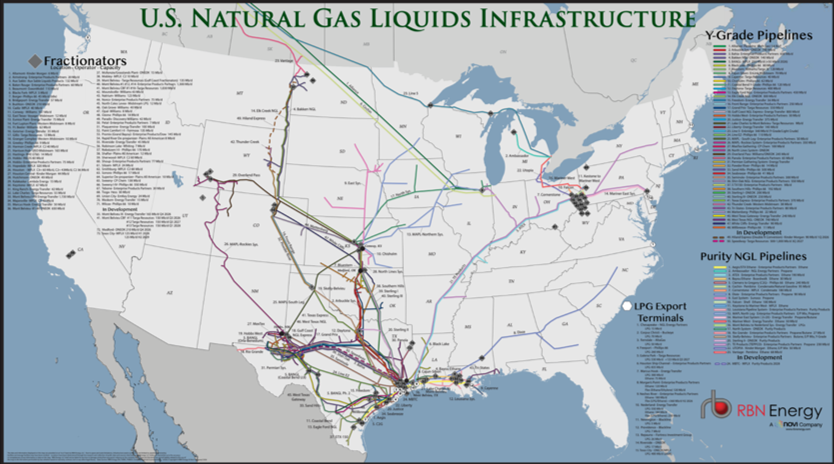
Figure 1. U.S. Natural Gas Liquids Infrastructure Map. Source: Novi Labs
CSV Midstream Announces 35 Mb/d Fractionator at Fort Saskatchewan
CSV Midstream Solutions announced on June 9 that it plans to build a 35 Mb/d fractionation plant in Fort Saskatchewan. Subject to regulatory approval, CSV expects to make a final investment decision (FID) on the project by early 2027, targeting startup in 2029.
Following the Y-Grade Highway
One of the most important functions of the map is showing how mixed NGLs move from producing regions to fractionation centers. The primary flow corridors originate in major producing areas, including the Permian Basin, Midcontinent, Eagle Ford, Western Canada, Bakken, Rockies and other interconnected basins. Many of those systems ultimately converge on two locations that dominate the North American NGL business: Mont Belvieu, TX, and Conway, KS.
For decades, these hubs have served as the central gathering points for NGL production, but the routes feeding them changed dramatically as shale production reshaped North American supply patterns. Seeing those connections laid out geographically helps explain why certain locations have become critical constraint points and why infrastructure investment has been concentrated around them.
The Center of Gravity
No discussion of NGL infrastructure would be complete without recognizing Mont Belvieu’s pivotal role as the industry’s central hub. More than any other location, it serves as the connection point between NGL production, fractionation, storage, petrochemical demand and the extensive Gulf Coast export network. Y-grade streams from producing basins across North America converge on Mont Belvieu, where they are fractionated, stored, traded and redistributed. From there, purity products move through pipelines serving petrochemical plants, retail markets and nearly every major NGL export terminal along the Gulf Coast. In many respects, Mont Belvieu is the place where the entire North American NGL value chain comes together.
Once fractionated, products leave the hub through major purity-product pipeline systems serving domestic consumers and industrial users. The map highlights systems such as Enterprise's TE Products Pipeline System (TEPPCO) serving Eastern markets and the Dixie Pipeline serving the Southeast, along with numerous pipelines supplying petrochemical facilities along the Gulf Coast.

Join us at our historic 20th School of Energy!
School of Energy: Foundations is a two day, in person conference designed to help energy professionals better understand the forces shaping crude oil, natural gas, NGLs, refined products, and petrochemicals.
Attendees will learn from RBN experts, work with Excel based analytical models, participate in Q&As, and network with industry peers.
Build the foundation to better navigate volatile energy markets.
Appalachia Changes the Game
Few developments have reshaped NGL logistics more than the rise of the Marcellus and Utica shales. Before the Shale Revolution, Appalachia was a minor player in NGL markets, with virtually no ethane recovery and little dedicated infrastructure. Today, the region supports one of the most extensive NGL transportation networks in North America, connecting producers to petrochemical markets, storage hubs and export facilities through a web of pipelines that scarcely existed a decade and a half ago.
The map includes major ethane pathways from the region. Ethane moves north to petrochemical facilities in Sarnia, ON. It moves east to export facilities at Marcus Hook, PA. And it moves south to Mont Belvieu through Enterprise’s ATEX pipeline system. These routes demonstrate how the NGL business has become increasingly interconnected and flexible. The same trend can be seen in propane markets, where growing Appalachian production has reduced dependence on traditional Gulf Coast supply routes into the Northeast.
Crossing Borders
The map also illustrates the highly integrated nature of North American NGL markets. Mixed NGLs move south from Canada into U.S. gathering, transportation and fractionation systems. At the same time, natural gasoline and naphtha move north to support oil sands blending requirements, while Bakken ethane moves into Canadian petrochemical markets.
These cross-border flows play a critical role in balancing regional supply and demand. The result is a North American market that functions as a single, interconnected system rather than a collection of isolated regional markets.
The Export Era
Perhaps the most striking feature of the NGL business in recent years has been the astronomical growth of exports. Fifteen years ago, exports represented a relatively small outlet for U.S. NGL production. Today, exports are the key demand driver for the entire market. The map identifies major export facilities along the Gulf Coast, including Houston, Nederland, Beaumont, Freeport, Corpus Christi and Louisiana, as well as Marcus Hook and other terminals on the East Coast and Ferndale, WA, in the Pacific Northwest.
Together, these facilities connect North American production to markets across Europe, Asia, Latin America and Africa. For all NGL products, especially propane and ethane, understanding export infrastructure has become just as important as understanding domestic demand.
The Big Picture
The value of a good infrastructure map isn't simply knowing where assets are located. It's understanding how they connect. Pipelines explain how products move. Fractionators explain where mixed streams become purity products. Export terminals explain how domestic production reaches global markets. Viewed individually, each asset tells only part of the story.
Viewed together, they reveal how the entire NGL value chain functions. That is the goal behind our new U.S. Natural Gas Liquids Infrastructure Map. It is a recognition that the NGL industry has become too large, too interconnected and too important to be understood one asset at a time. Sometimes you need to step back and look at the big picture.
To learn more about the U.S. Natural Gas Liquids Infrastructure Map and optional data set, click here.

About the song
“Maps” was written by Brian Chase, Karen Lee Orzolek and Nick Zimmer. It appears as the third song on the Yeah Yeah Yeahs’ debut studio album, Fever to Tell. The song features the band’s minimalist approach to vocals, guitar and drums. The lyrics were inspired by troubles with vocalist Karen O’s relationship with Liars frontman Angus Andrew. It is rumored that Maps stands for “My Angus please stay.” Released as a single in September 2003, it went to #9 on the Billboard Modern Rock Tracks and #87 on the Billboard Hot 100 Singles charts. Personnel on the record were: Karen O (vocals), Nick Zimmer (guitars) and Brian Chase (drums).
Fever to Tell was recorded in 2002 at Headgear in New York City and produced by David Andrew Sitek and the Yeah Yeah Yeahs. Critics have described the band as garage rock and art punk, with comparisons to Siouxsie and the Banshees and Lydia Lunch. The album was released in April 2003 and went to #55 on the Billboard 200 Albums chart. It has been certified Gold by the Recording Industry Association of America. Four singles were released from the LP.
Yeah Yeah Yeahs are an American indie rock trio formed in New York City in 2000 by vocalist Karen O, guitarist Nick Zimmer and drummer Brian Chase. They released their self-titled EP on their own indie label in July 2001 and signed to Interscope Records in 2002. They have released five studio albums, two EPs and 18 singles. They last toured in 2025 on their Hidden in Pieces Tour in North America.
"About the Song" -- written by Mickey McMahan , RBN Director of Musicology


