You are here

Railing Against the Pipelines – How New Rail Terminals Evaporated the Bakken WTI Discount

Over the past two weeks, crude oil prices at Clearbrook and Guernsey have, for the second time this year, closed the gap between the Bakken and West Texas Intermediate (WTI) prices.  Bakken prices are up and there is a simple explanation why.  New rail terminals - both in the Bakken and at refining centers on the East and Gulf Coasts. In today’s blog we explain why Bakken prices are rising and what the implications are for rail shippers out of the region.

The chart below shows the Bakken discount to WTI (magenta line), WTI (green line at zero) and the Light Louisiana Sweet (LLS) premium over WTI (red line). To understand the chart we need to make two big points clear so lets go ahead and make those points first while you look at the chart. We will explain each point in detail in a minute. The first big point is that the Bakken discount to WTI is narrowing and has crossed into positive territory a couple of times since May – right now the discount is $0.50/Bbl. The second big point is that the LLS premium to WTI (red line) has widened over the same time period since the Bakken Discount to WTI started to narrow. 
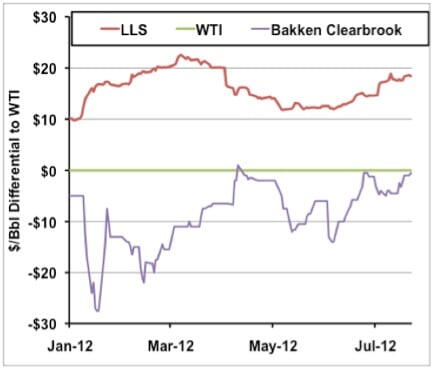
Now lets talk through the first big point. The Bakken discount to WTI is narrowing. Generally speaking if producers sell their crude in North Dakota, the price they receive is related to WTI. We explained how this works in Part I of  “The Bakken Buck Starts Here”. Bakken prices at the Clearbrook and Guernsey hubs traded at hefty discounts to WTI for much of the first quarter of this year (and a large part of last year) because of pipeline capacity constraints out of the Bakken and a logjam at Cushing OK that is preventing rising Canadian and Bakken crude production from reaching Gulf Coast refineries. That meant the Midwest refinery market was oversupplied and Bakken barrels were discounted against WTI. The good news for Bakken producers selling crude in North Dakota is that as the chart shows, the Bakken discount to WTI is disappearing. Why is this happening? The answer is new rail terminals – both in North Dakota and at refining centers outside the Midwest.

First the Bakken terminals  - we reported previously on extensive plans for building new rail takeaway capacity (see “Bakken: If Railing Crude is Wrong I Don’t Wanna be Right” and “Rail it on Over to Albany – Moving Bakken East”). The chart below from the North Dakota Pipeline Authority tells us all we need to know on the topic. By the end of this year, rail capacity out of the

Bakken is expected to have increased from 275 Mb/d in 2011 to 775 Mb/d – a year on year increase of 280 percent. Three new large and efficient rail terminals have come on line in the past two months. These are the Rangeland COLT terminal near Epping ND (120 Mb/d capacity), an upgrade to the Musket Terminal at Dore, ND (now 60 Mb/d capacity) and the Savage Services Terminal in Trenton ND (90 Mb/d capacity). The latest (June 2012 preliminary) Bakken crude production numbers from the North Dakota Industrial Commission are 660 Mb/d. The new Bakken rail capacity could handle all that production and more.

Second - refinery rail terminals. New terminals are being built close to refining capacity outside the Midwest. Rail terminals have been completed this year that are designed to attract crude oil deliveries to refineries on the East Coast and Gulf Coast. Global Partners LP is more than doubling rail capacity at its Albany, New York, terminal to accommodate up to 120 Mb/d of oil from rail cars that can then be shipped to refineries on the East Coast by barge. The St James rail terminal  – gateway to Louisiana Gulf Coast refineries is expanding it capacity to handle 2 unit trains a day (130 Mb/d) this summer. Additional terminals have been announced at Westville PA and by the new owners of the refinery formerly owned by Sunoco in Philadelphia (see “Beginning to See the Light”). These new receiving terminals expand the rail destination options for Bakken shippers.

Utilization of the new rail capacity to ship crude out of the Bakken is ramping up fast and to understand why we need to look at the pipeline situation in the Bakken. The usual rule of crude transportation is that pipes are cheaper than rails and therefore you choose a pipeline if you have the chance. As we described in “The Bakken Buck Starts Here – Bakken Crude Pricing Part III“ there are two mainline alternatives to ship crude out of the Bakken on pipes – the Enbridge system to Clearbrook MN or the Butte Pipeline to Guernsey WY. As we write the capacity on these systems is 360 Mb/d with another 75 Mb/d due online by the end of the year on the Plains Bakken North Pipeline. This tells us that pipeline capacity is tight out of the Bakken – i.e. 660 Mb/d of production will not all fit into the current pipeline capacity. That tight pipeline capacity explains why the rail terminals were financed and built in the first place. Producers were concerned that there wouldn’t be room on the pipeline for their crude, so they made volumetric commitments  (effectively take-or-pay deals) to support the construction of rail terminals.

The new rail capacity is suddenly beginning to look attractive compared to the pipelines. That’s because barrels delivered through both Bakken takeaway pipeline systems end up in Chicago where they are competing with too many other Midwest barrels backing out of the Cushing logjam. That logjam is restricting the volume of crude that can get beyond Cushing by pipeline to Gulf Coast markets. Because of the logjam the price of the Midwest Cushing benchmark crude WTI has traded at a $20 or higher discount to Gulf Coast crudes for most of the past two years. That brings us back to the second big point in our first chart. LLS prices are still trading way above WTI and that differential is increasing.  As a result, rail transport has become a more attractive option because it offers producers in the Bakken the chance to deliver to destinations other than Cushing – including those like the Gulf Coast where prices are not weighed down by the Cushing logjam. So at the moment rail transport is able to offer better capacity and destination flexibility - making the pipelines less competitive.

The very attractiveness of the rail transport option in this situation is however, causing the Bakken differential to WTI to narrow (that was our first big point). As rail shippers switch barrels away from the pipelines and as refiners on the East Coast and the Gulf Coast create demand for cheaper Bakken crude, the discount to WTI is evaporating. This is fantastic news if you are a Bakken producer selling your crude in North Dakota – your price just went up! 

The picture is not so rosy however for those Bakken shippers and producers that signed up for rail capacity in the hope of reaching higher priced markets. That is because the costly economics of rail transport to far off locations like Albany New York and St James Louisiana rely on receiving a hefty premium for the crude you deliver versus what you paid for it (shipper) or might have sold it for in North Dakota (producer). The disappearance of the Bakken discount to WTI is eating into both these player’s profits. Producers might have done better to sell their crude in North Dakota now the discount to WTI is evaporating. Shippers have to buy their crude in North Dakota at inflated prices. Both parties are stuck with commitments to rail transport.

 Not everything is bad for those with rail capacity commitments. Their hopes are still kept alive by the prospects of high LLS premiums over WTI – the second big point in our chart. The LLS price trades closer to the international Brent crude market since it competes against imported crudes that are priced against Brent. (We explained the Brent/WTI/LLS dynamic more completely in the “A Bridge Too Far - When will the WTI Discount to Brent End?”). At the moment – mainly as a result of the Cushing logjam preventing Midwest crudes from reaching the Gulf, LLS is trading at a premium to WTI of around $19. So rail shippers and producers still have $19 to play with before they start losing money.

Back in May, we estimated the cost of rail transport to Albany plus barge costs to reach the East Coast at $22/Bbl (see “Rail it on Over to Albany – Moving Bakken East”) and if those costs still persist then Bakken producers would be losing $3/Bbl in transport costs. The other “destination of choice” is St James LA and the rail costs to there from North Dakota vary by circumstance. You can go on the BNSF railroad company website (BNSF ship about 75 percent of all crude leaving the Bakken) and get a baseline quote to St James LA of $12.22/Bbl but there are all kinds of add-ons that probably bring the cost closer to $18-$20/Bbl.

So right now the rail option might well be paying off for some shippers and producers who have negotiated lower than published rates with the railroads. However, there are some pretty dark clouds on the horizon. Those dark clouds come in the shape of the Seaway expansion from Cushing to Houston and 160 Mb/d of new takeaway capacity from the Bakken on Enbridge and Plains pipelines early in 2013. The new capacity on Seaway could finally unwind the Cushing logjam and the effect of that will be to reduce the WTI discount to LLS to something like $7/Bbl – the cost of pipeline transport from Cushing to St James LA. New pipeline capacity out of the Bakken will create more competition for new production barrels – keeping the Bakken discount to WTI close to par. Between them these factors will effectively demolish the premiums that Bakken shippers and producers can get today for the barrels they ship by rail to the East Coast and the Gulf.

Some Bakken producers will be glad to see that the much-maligned discount to WTI they get paid for their crude is evaporating. The producers and shippers who signed up for Bakken rail capacity in the belief that premium prices on the coast would protect them from high rail transport costs, probably did not plan on such a rapid end to the Bakken WTI discount. They need to pray that LLS prices stay detached from WTI while their rail commitments last. Unfortunately their destiny is in the hands of the pipelines out of Cushing and the Bakken and the owners of those pipelines may not be sympathetic to their cause.


Each business day RBN Energy posts a Blog or Markets entry covering some aspect of energy market behavior. Receive the morning RBN Energy email by simply providing your email address – click here.